Private IP address ranges: RFC 1918 and every other reserved block
The three private IPv4 ranges from RFC 1918, every other block that can never be public, and how much of IPv4 that is: 13.8 percent, by IANA's own registries.
On this page
The private IP address ranges are 10.0.0.0/8, 172.16.0.0/12 and 192.168.0.0/16. RFC 1918 set them aside in 1996 for networks that do not talk to the internet directly, 17,891,328 addresses in all. Many more addresses can never be public either. Counted from IANA's own registries, 592,708,607 IPv4 addresses, 13.8 percent of the whole space, are reserved in one way or another (November 3, 2026).
#What are the private IP address ranges?
RFC 1918 says IANA "has reserved the following three blocks of the IP address space for private internets": 10.0.0.0 to 10.255.255.255, 172.16.0.0 to 172.31.255.255, and 192.168.0.0 to 192.168.255.255. Anyone may use them without asking. IANA adds that "we have no record of who uses which of these addresses".
| Block | In class terms | Addresses |
|---|---|---|
| 10.0.0.0/8 | One class A | 16,777,216 |
| 172.16.0.0/12 | 16 class Bs | 1,048,576 |
| 192.168.0.0/16 | 256 class Cs | 65,536 |
The class terms come from RFC 1918 itself, which calls the first block "a single class A network number", the second "a set of 16 contiguous class B network numbers" and the third "a set of 256 contiguous class C network numbers". Classes stopped deciding anything on the internet long ago, but the words stuck, and that is why courses still ask for the private range of class A, B or C.
Mind the edges. ARIN warns that "only a portion of the '172' and the '192' address ranges are designated for private use", and that the rest is public. A filter for every address that starts with 172 blocks real networks: only 172.16 to 172.31 is private.
#Which other IP address blocks are reserved?
IANA keeps a registry of special-purpose blocks, and RFC 6890 explains its columns. One of them says whether a block is globally reachable. Together with multicast, these are the blocks that can never be a normal public address:
| Block | What it is for | Addresses |
|---|---|---|
| 100.64.0.0/10 | Carrier NAT, shared | 4,194,304 |
| 127.0.0.0/8 | Loopback | 16,777,216 |
| 169.254.0.0/16 | Link-local | 65,536 |
| 0.0.0.0/8 | "This network" | 16,777,216 |
| 192.0.2.0/24 and two more | Docs and examples | 768 |
| 198.18.0.0/15 | Benchmarking | 131,072 |
| 224.0.0.0/4 | Multicast | 268,435,456 |
| 240.0.0.0/4 | Future use | 268,435,456 |
RFC 5737 reserves 192.0.2.0/24, 198.51.100.0/24 and 203.0.113.0/24 "for use in documentation", which is why examples in manuals use them. 100.64.0.0/10 is the shared space RFC 6598 set aside for carrier-grade NAT, where a provider puts many customers behind one public address. Our guide to CGNAT explains what that does to blocking.
#How much of IPv4 can never be public?
We took every block IANA's registry marks as not globally reachable, added multicast, counted overlapping blocks once and gave back the few addresses inside them that IANA marks reachable. The result: 592,708,607 of the 4,294,967,296 IPv4 addresses, 13.8 percent. Two blocks make up nearly all of it. Multicast and the block reserved for future use each hold 268,435,456 addresses, 6.25 percent of the space.
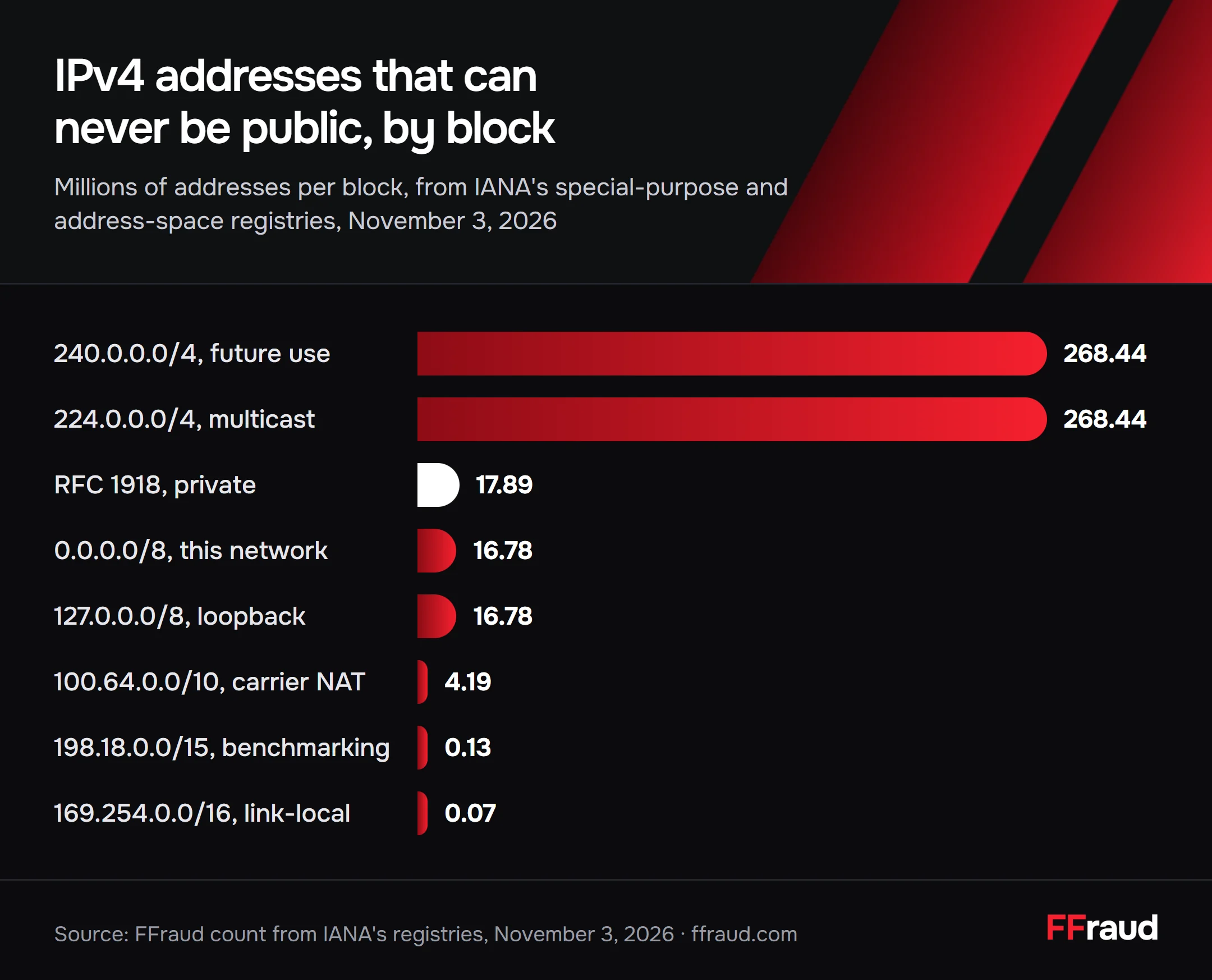
- 240.0.0.0/4, future use268.44
- 224.0.0.0/4, multicast268.44
- RFC 1918, private17.89
- 0.0.0.0/8, this network16.78
- 127.0.0.0/8, loopback16.78
- 100.64.0.0/10, carrier NAT4.19
- 198.18.0.0/15, benchmarking0.13
- 169.254.0.0/16, link-local0.07
Source: FFraud count from IANA's registries, November 3, 2026
The private ranges are only 0.42 percent of IPv4, yet they carry most home and office networks. IANA puts it plainly: "There are millions of private networks (for example home firewalls often use them)."
#How do you choose a private range for your network?
For a home network the choice hardly matters, since its addresses never leave the house. It starts to matter when two private networks must be joined, by a VPN or after two companies merge, and both picked the same range. The network engineer Ben Cartwright-Cox counted which ranges 1.79 million home and office network drives used in June 2025:
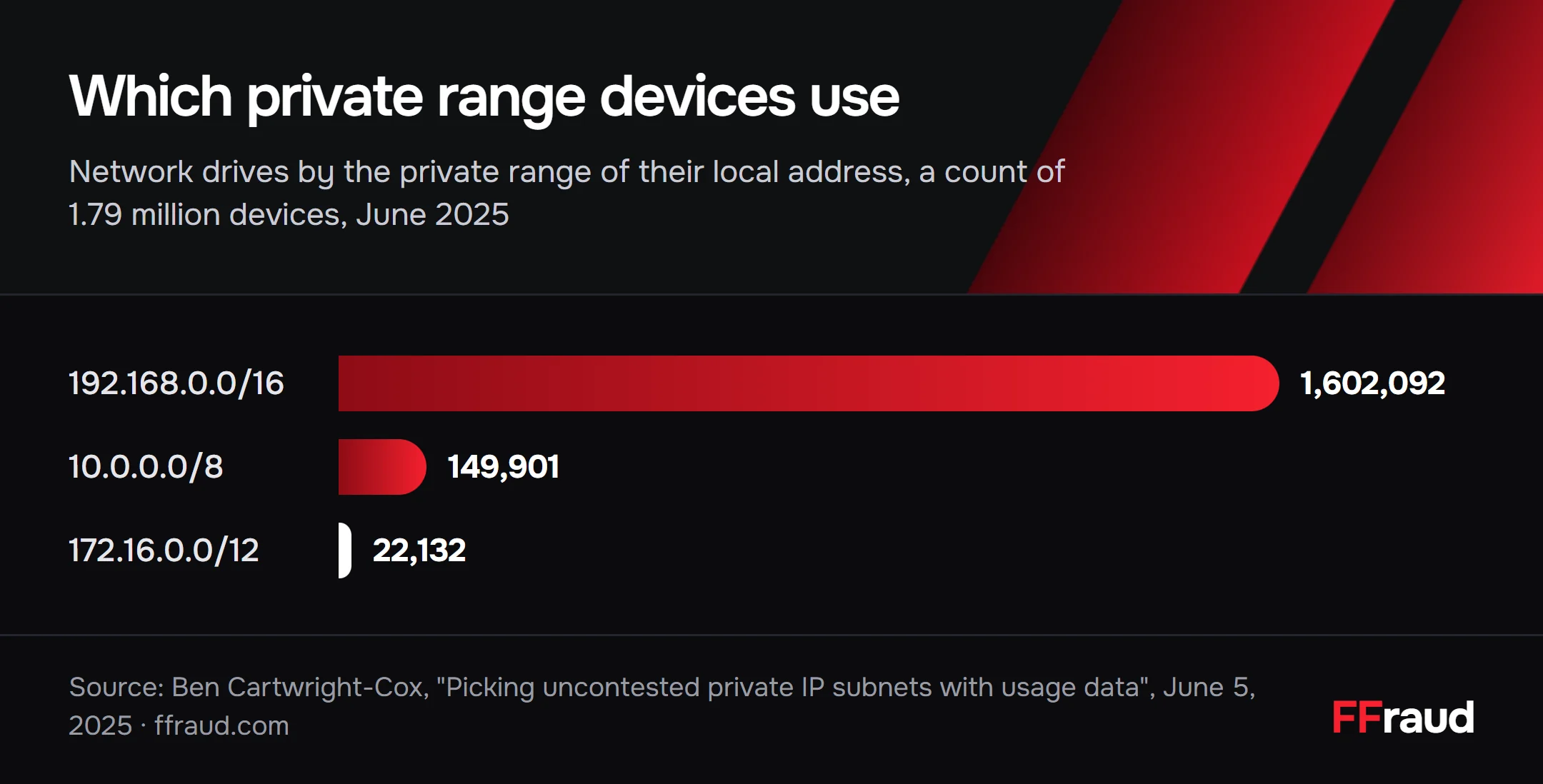
- 192.168.0.0/161,602,092
- 10.0.0.0/8149,901
- 172.16.0.0/1222,132
Source: Ben Cartwright-Cox, "Picking uncontested private IP subnets with usage data", June 5, 2025
192.168 dominates because home routers ship with it. So if your network may one day meet another, a block inside 172.16.0.0/12 is the least likely to collide.
#What about IPv6?
IPv6 has its own private block. RFC 4193 reserves fc00::/7 for unique local addresses, the IPv6 counterpart of RFC 1918, and IANA keeps a second special-purpose registry for the other IPv6 blocks. A share of the IPv6 space would say little, since that space is so large that every reserved block is a rounding error.
#What does a private address in your logs or a blocklist mean?
IANA says the private blocks "should never appear in the public Internet". It also tells anyone who sees an attack from one of them that "either it is coming from your local environment, your ISP, or the address has been 'spoofed'". On a server facing the internet, a private source address usually means a proxy or load balancer of your own, so read the real client address from its headers, as our guide to the real client IP shows.
- A blocklist that names a private or reserved address is broken. We checked FFraud's own malicious IP database: none of its 1,624,273 IPv4 addresses (build of November 3, 2026) falls in a reserved block.
- FFraud's free IP lookup answers any private or reserved address as a private network with a fraud score of 0.
- Wider bogon lists also cover address space no network has been given yet. Our comparison of free IP blocklists covers one of them.
#Questions people ask
What is the private IP address range for class A, B and C?
Class A: 10.0.0.0 to 10.255.255.255. Class B: 172.16.0.0 to 172.31.255.255, sixteen class B networks. Class C: 192.168.0.0 to 192.168.255.255, 256 class C networks.
Which IP address range is defined as private by RFC 1918?
Three: 10.0.0.0/8, 172.16.0.0/12 and 192.168.0.0/16, 17,891,328 addresses together.
How do you tell if an IP address is private?
Check the first numbers. It starts with 10, with 192.168, or with 172 followed by 16 to 31. Any other 172 or 192 address is public, as ARIN points out.
How do you choose a private IP range?
Any of the three works at home. If your network may be joined to another, pick a block inside 172.16.0.0/12: in a count of 1.79 million devices it was the least used.
Is 100.64.x.x a private address?
Not under RFC 1918, but it is not public either. RFC 6598 reserves 100.64.0.0/10 as shared space for carrier-grade NAT.
Sources
- RFC 1918: Address Allocation for Private Internets
- RFC 5737: IPv4 Address Blocks Reserved for Documentation
- RFC 6598: IANA-Reserved IPv4 Prefix for Shared Address Space
- RFC 6890: Special-Purpose IP Address Registries
- RFC 4193: Unique Local IPv6 Unicast Addresses
- IANA IPv4 Special-Purpose Address Registry
- IANA IPv4 Address Space Registry
- Private-use IP addresses
- IPv4 Private Address Space and Filtering
- Picking uncontested private IP subnets with usage data
- ip-fraud-database: confirmed abusive IPs (open data, MIT), build of 18:31 UTC